Helping Patients See Clearly at Every Distance

The surgeons and the team at Pacific Vision Institute have long been committed to offering patients the most advanced lens options in cataract and refractive surgery. A Castle Connolly Top Doctor for 15 consecutive years and members of the American Society of Cataract and Refractive Surgery, Dr. Faktorovich, Dr. Parra, and Dr. Seibel bring both the expertise and the technology to help patients achieve their best possible vision at every stage of life.

What Are Multifocal Lenses?

Multifocal intraocular lenses (IOLs) are premium artificial lenses implanted during cataract surgery or refractive lens exchange. Unlike monofocal lenses, which provide clear vision at only one distance, multifocal IOLs feature multiple optical zones that allow the eye to focus at near, intermediate, and far distances simultaneously.

The brain learns to select the appropriate focal point for each visual task, resulting in functional vision across a wide range of distances with significantly reduced reliance on corrective eyewear.

Benefits of Multifocal Lenses

  • Clear vision at near, intermediate, and distance ranges
  • Significant reduction in glasses and reading glass dependence
  • Permanent implant — no maintenance or replacement needed
  • Improved quality of life for active patients
  • Strong near vision for reading and detail-oriented tasks

Are You a Candidate for Multifocal Lenses in San Francisco?

Multifocal lenses may be a good fit if you:

  • Are undergoing cataract surgery and want to minimize glasses use
  • Value strong near vision for reading, hobbies, or fine detail work
  • Are willing to allow a short neural adaptation period as your brain adjusts
  • Do not have significant corneal irregularities or macular disease
  • Understand that some patients experience mild halos or glare, especially at night
  • Have discussed your full visual needs and lifestyle with PVI surgeons
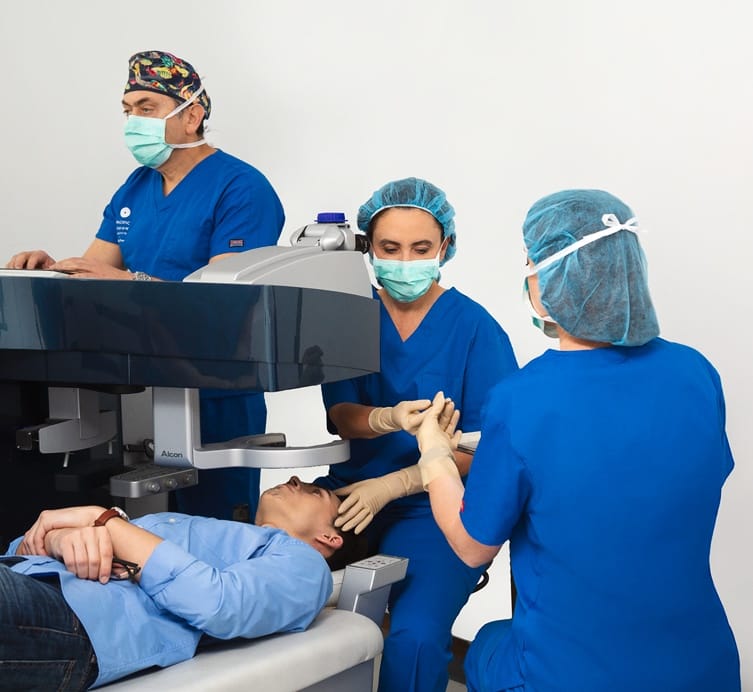
Dr. Faktorovich working on a patient's eyes

Why Choose Pacific Vision Institute for Multifocal Lens Implants?

Pacific Vision Institute is recognized among the Leading Medical Clinics of the World — one of only a handful of U.S. practices to hold this distinction. Our surgeons’ individualized approach to surgical planning draws on decades of research, their proprietary treatment algorithms, and extensive experience with the full range of premium IOL technologies. The PVI surgeons help each patient weigh the tradeoffs of every lens option with clarity and candor.

What to Expect

Consultation and Preoperative Examination

  • Full ocular health evaluation and candidacy assessment
  • Extensive measurements of your eye’s optics and focusing system
  • Advanced 4-scan topography, ocular biometry, tomography, anterior and posterior segment OCT
  • Discussion of lens options tailored to your vision goals
  • Thorough discussion of financial options

Procedure Steps

  • Performed as part of cataract surgery or refractive lens exchange
  • Natural lens is removed using advanced ultrasound techniques
  • Extended range IOL is precisely implanted in the lens capsule
  • Procedure typically completed in under 30 minutes per eye

Recovery & Results Timeline

  • Many patients notice improved vision within the first 24–48 hours
  • Neural adaptation, the brain's adjustment to multifocal optics, may take several weeks
  • Mild halos or glare at night are common early on and often diminish over time
  • Follow-up visits at 1 day, 1 week, and 1 month post-procedure

Schedule Your Multifocal Lens Consultation in San Francisco

Freedom from reading glasses could be within reach. Contact Pacific Vision Institute today to schedule a consultation with our surgeons and find out whether multifocal lenses are the right choice for you.

Frequently Asked Questions About Multifocal Lenses

How long does neural adaptation to multifocal lenses typically take?

Neural adaptation, the process by which the brain learns to select the correct focal zone, generally takes anywhere from a few weeks to a few months. Most patients report that visual quality continues to improve gradually throughout this adjustment period.

Are multifocal lenses suitable for patients with dry eye?

Significant dry eye can affect visual quality with any IOL, and this is particularly true with multifocal lenses, which depend on a stable tear film for optimal performance. PVI doctors will evaluate and, when necessary, treat dry eye prior to surgery to help maximize your outcomes.

Can multifocal lenses be implanted after a previous LASIK procedure?

Patients who have had prior LASIK or PRK can still be candidates for multifocal IOLs, though the pre-surgical measurements require additional adjustments to account for the reshaped cornea. Our surgeons’ experience in both refractive surgery and lens implantation makes her particularly well-suited to evaluate and treat this patient population.

What causes the halos and glare some multifocal lens patients experience?

Halos and glare result from the multiple optical zones of the lens bending light simultaneously, creating visual artifacts — especially around bright lights at night. For most patients, these symptoms decrease significantly as neural adaptation progresses over weeks to months.

Is one brand or model of multifocal lens better than others?

Multiple well-studied multifocal IOL platforms are available, each with optical designs tailored to specific visual needs and lifestyles. Our surgeons select among the available options based on each patient's ocular measurements, visual priorities, and history.

What if I am unhappy with my multifocal lens results?

While most patients are satisfied with their outcomes, a small percentage may experience persistent visual disturbances that affect quality of life. In these cases, options such as additional refractive procedures or, in rare circumstances, lens exchange can be explored with PVI surgeons.

Do multifocal lenses affect color vision or contrast sensitivity?

Some multifocal lens designs can slightly reduce contrast sensitivity compared to monofocal lenses, which may be noticeable in low-light environments. Most patients find this trade-off acceptable given the significant reduction in dependence on glasses, and advances in lens technology continue to narrow this gap.

Are multifocal lenses covered by Medicare or insurance?

The underlying cataract surgery is generally covered by Medicare and most insurance plans, but the premium multifocal IOL upgrade is an additional cost borne by the patient. Pacific Vision Institute's team will help you understand exactly what is and is not covered before your procedure.

Schedule a Consultation

Send us a message to schedule an in person consultation at our office in San Francisco.

Schedule
Schedule a Consultation

Get Started Send Us A Message